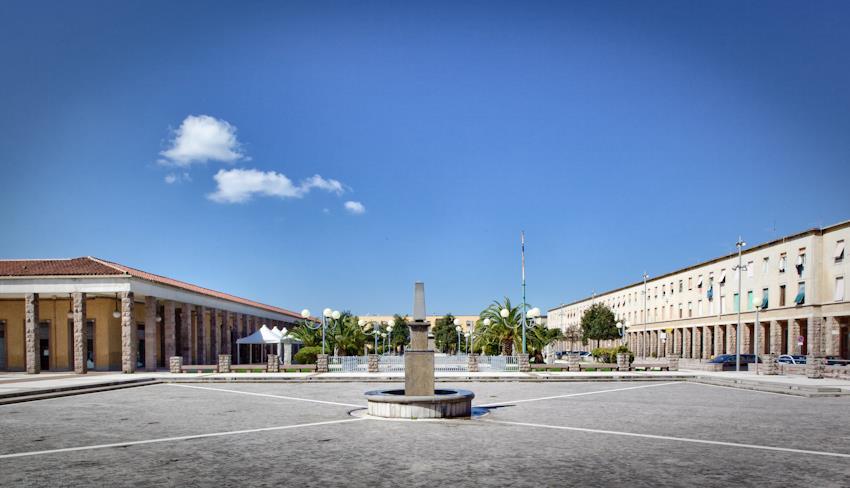
It is a large square with a Rationalist layout, designed for social life and services. Long buildings with porticoes mark the perimeter. They create a unified frontage and a covered walkway, transforming the space into an “open-air hall” for the neighbourhood.
The square is a document of local history. During the Ventennio, the settlement was known as “Villaggio Umberto”. It was inaugurated on 15 May 1942.
In the post-war period, Cortoghiana changed its name and economic prospects. Piazza Venezia, however, has preserved its role as an everyday hinge. It remains a point of orientation and a space for events, meetings, and community initiatives.
The value of the square is understood better by looking at the overall layout. Cortoghiana was created with an orderly and functional structure, typical of Rationalist urban planning. Streets and blocks lead to the large central space. From a design point of view, Piazza Venezia also tells what was not completed. Sources indicate that the original design was more articulated than what was built. It included a further extension to the west, a cinema as a closing element, and, in the centre, a rectangular porticoed building. In some drawings, this building is indicated as the town hall. Subsequent changes updated the functions without cancelling the layout. These changes include the construction, in the post–Second World War period, of the church of the Sacro Cuore di Gesù within the context of the square. Even today, the regularity of the porticoes still shows the original idea: a community built around work and a large shared space.