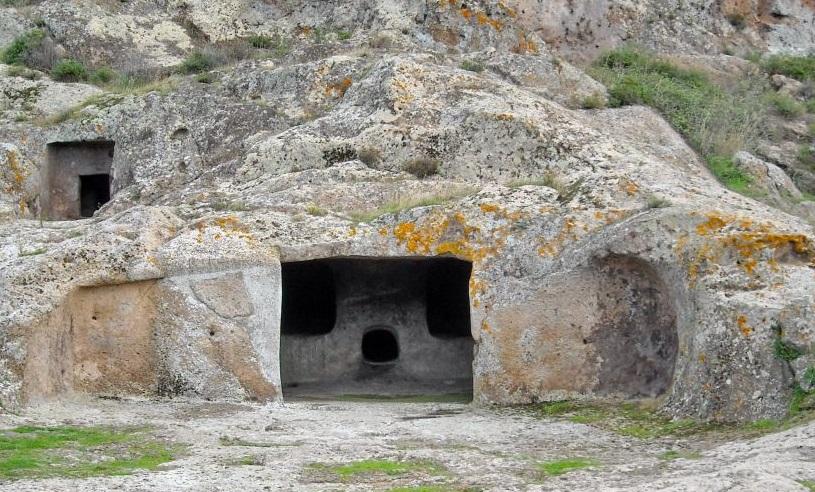

Montessu Necropolis, a UNESCO World Heritage Site
Montessu is in the Sulcis area, in the territory of Villaperuccio, a few kilometres from Carbonia. It is one of the largest pre-Nuragic necropolises in southern Sardinia.
The site allows you to visit a large complex of domus de janas, rock-cut tombs also known as “fairy houses”. It lies on the southern flank of the hill of Sa Pranedda. The trachyte forms a natural amphitheatre, and on that rock face more than forty tombs open.
Montessu is striking because the domus are not arranged at random. Many are aligned along the rock, with an arrangement that appears symmetrical. The impression is of a place “built” in the full sense of the term, even if not raised vertically.
The tombs show different solutions. Some are very simple, with a circular chamber and a low vault. Access is through a narrow small door. The deceased was introduced and laid in a foetal position.
More often, the scheme is multi-cell. A larger chamber is flanked by raised niches. The spaces are preceded by curvilinear or rectangular vestibules. The entrances could be closed by stone doors, fixed in recesses made on the threshold. In other domus, antechambers and chambers follow one another. Parts are delimited by orthostatic structures. This way of “building” suggests a hierarchy of spaces and ritual gestures.
At the end of the amphitheatre there are two monumental tombs, facing each other. Megalithic alignments delimit them and define semicircular spaces. They have a wide entrance pavilion and three openings leading to the back room. Inside, carved benches help organise the interior into different areas. Holes in the floor and in the ceiling testify to reinforced closure systems, with wooden poles. Here Montessu suggests that some tombs had a particular role, closer to the idea of a “sanctuary” than to that of a simple burial.
The site is also marked by carved symbols. Some domus show relief motifs, including spirals, concentric figures, and bull protomes.
The “tomba delle spirali” preserves decorative elements and the “falsa porta”, a sign that refers to the passage into the afterlife.
The “tomba delle corna” shows horn-shaped motifs linked to the cult of the bull-god. They are essential traces, but eloquent. They describe a religiosity made of repeated and shared images.
Montessu was used for centuries. The ceramics found indicate long use, from the Late Neolithic to the Early Bronze Age. Studies cite cultures such as Ozieri, Abealzu-Filigosa, Monte Claro, Vaso campaniforme, and Bonnanaro. Ceramics attributed to the culture of El Argar confirm that prehistoric Sardinia was not isolated, but crossed by contacts and movements in the western Mediterranean.
Research began in 1972 under the guidance of Enrico Atzeni and continued in several campaigns.
The finds are now preserved in the archaeological museums of Cagliari and Santadi.
In 2025, the UNESCO recognition dedicated to the funerary tradition of the domus de janas also included Montessu.
The value is not only in the number of tombs, but in the quality of the story they can offer. Here it is clear how a prehistoric community transformed rock into a place of memory, uniting excavation technique, spatial organisation, and religious symbols.
The valley also includes an archaeological park with a corridor megalithic tomb, two nuraghi, and two menhir about five metres tall. This landscape shows continuity and transformations. It places several “languages” of stone side by side. This is why Montessu leaves a strong impression: it makes visible how deep the history of the Sulcis is.