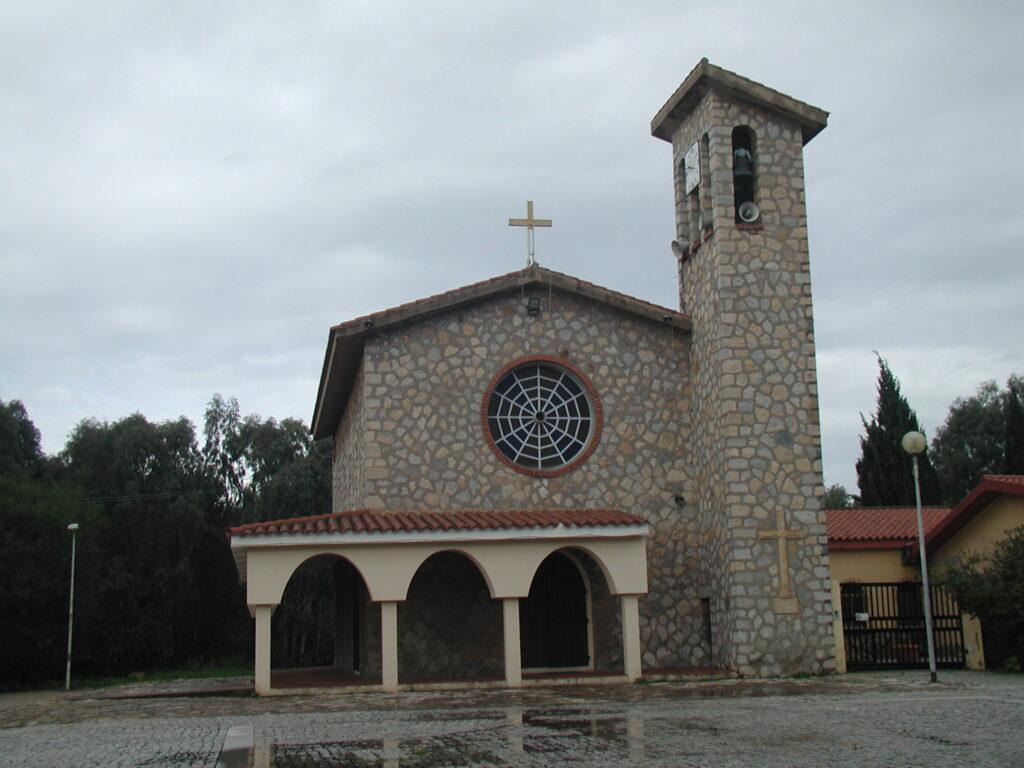

Bacu Abis and the Church of Santa Barbara.
Bacu Abis, today a hamlet of Carbonia, is a workers’ village created for the development of coal deposits. In the 1930s it became a true “laboratory” of Rationalist urban planning. The oldest core is already linked to extractive activities in the 19th century. A first clearly recognisable settlement centre was consolidated with the Case Congia (1914).
Between 1936 and 1938 the settlement was reorganised under a plan by Gustavo Pulitzer-Finali. The new layout provided a centre for public and civic functions and a residential fabric arranged “in orderly rows”. Housing was distributed in a hierarchical way, not only by type but also by position in relation to services. In this logic, 20 blocks were intended for miners and 3 blocks for employees. From 1937, Bacu Abis was incorporated into the newly founded Carbonia and provided with decentralised municipal services.
The most iconic point is the main square, or rather a system of squares and open widenings. Here stand the places of community life and propaganda: the dopolavoro (workers’ leisure club) and the cinema-theatre, the spaccio (store) and the Casa del Fascio. These buildings are in dialogue with the Church of Santa Barbara, patron saint of work in the mine.
The church is located north of the settlement and asserts itself as an urban “marker”. It has a single nave, lit by side openings and by a large oculus on the façade. It features exposed stone facing, a continuous portico, and an attached quadrangular bell tower. This is the classic civic-and-religious setting that, in the architecture of the period, organised everyday life and the representation of power within the same public space.
A technical report by the Municipality of Carbonia notes that, between 1935 and 1937, Arsia and Bacu Abis were created almost simultaneously and with corresponding aims. For Arsia, the commission to the Trieste-based studio led by Gustavo Pulitzer-Finali is documented. For Bacu Abis, the documentation is more fragmentary. Even so, the urban and architectural similarities are considered strong enough to support the hypothesis of a possibly joint planning approach. The parallel is presented as grounded, but a “replica”, in the strict sense, is not stated as an absolute certainty.